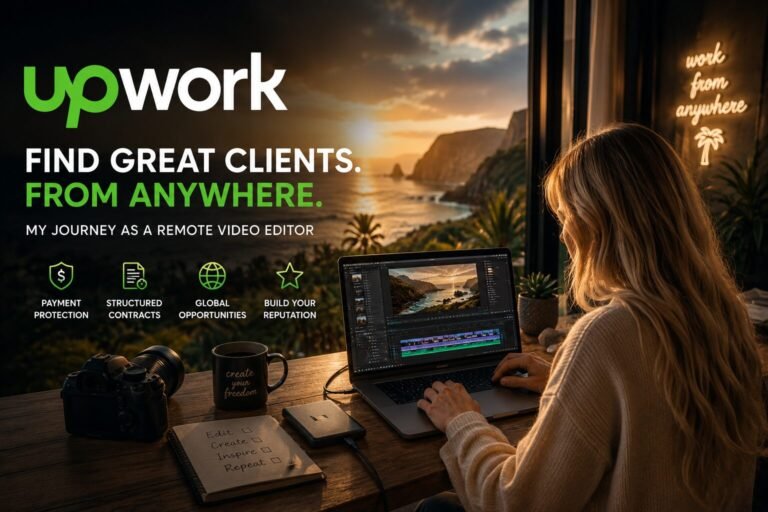
I work remotely as a video editor, producing short-form ads and branded content for clients across different industries. My office is wherever I have a good internet connection, which right now happens to be Tenerife. Finding clients in that setup used to feel like the hardest part of the job.
Upwork changed that. Not overnight, but steadily. And now it’s one of the first places I go when I’m looking to take on new work.
So, how does Upwork actually work?
Upwork is a freelance marketplace where businesses post jobs and independent professionals apply for them. Think of it as a job board — but built specifically for project-based, remote work.
Here’s the basic flow:
1: Create a profile
You set up your profile like a public portfolio, your skills, experience, hourly rate, and work samples. For me, that means video examples and a clear description of what I do.
2: Browse and apply for jobs
Clients post projects — either fixed-price or hourly. You submit a proposal, introduce yourself, and explain why you’re a good fit. Upwork uses “Connects” (small tokens) to apply, which keeps the quality of applicants higher.
3: Get hired and start the contract
The client reviews proposals, and if they choose you, a contract is created through the platform. Everything is documented: deliverables, deadlines, revisions.
4: Work, deliver, get paid
For fixed-price jobs, the client deposits funds into escrow before work begins — meaning the money is already secured. For hourly contracts, Upwork tracks hours automatically. Payment comes through the platform.
5: Build your reputation
After each project, both sides leave a review. Over time, your profile builds up — and a strong track record makes every next proposal more convincing.
Why it works well for remote freelancers
One of the biggest challenges of freelancing remotely is trust — both ways. Clients don’t know you, you don’t know them, and there’s no office handshake to bridge that gap. Upwork handles a lot of that friction by design.
“The money is already sitting in escrow before I open a single project file. That alone changes everything.”
The payment protection is real. For fixed-price projects, the client funds the milestone upfront. That means I can focus on the work, not on whether I’ll actually get paid. And because all communication happens on the platform, there’s always a clear paper trail if questions come up.
As a video editor, I also appreciate how specific you can get with your profile. I work on short-form ads, brand content, and social video — and I can signal exactly that. Clients searching for those skills find me, rather than me having to cast a wide net everywhere.
What makes it beginner-friendly
When I started, I didn’t have a long client list. Upwork doesn’t require one. Your profile, your samples, and how you write your proposals do the talking. A focused niche helps a lot — being clear about what you do tends to outperform trying to appeal to everyone.
Payment protection
Funds secured before work starts on fixed-price projects.
Structured contracts
Scope, milestones, and revisions agreed in writing upfront.
Global client base
Clients from the US, Europe, and beyond, location doesn’t limit who you work with.
Review system
Every project builds your public track record. Good work compounds.
The first few weeks are the slowest — that’s true for most platforms. But once you have a couple of completed projects and solid reviews, it picks up. The algorithm starts surfacing your profile more, and proposals land better when there’s something to back them up.
What I’d tell anyone starting out
Be specific on your profile. “I edit videos” is too broad. Something like “I edit short-form ads and social content for product and lifestyle brands” gives a client an immediate sense of whether you’re right for their job. Show your best work, even if it’s a small selection.
Start with smaller projects to build reviews. Not because the work is lesser — but because a five-star review from a $200 project is worth more than a blank profile when you go after larger ones.
And be patient with the first few applications. The system works, but it takes a little time to warm up. Once it does, it’s one of the most consistent ways I know to find real, paying work — from anywhere.
Ready to start?
Create your free Upwork profile and start applying today. Go to Upwork →